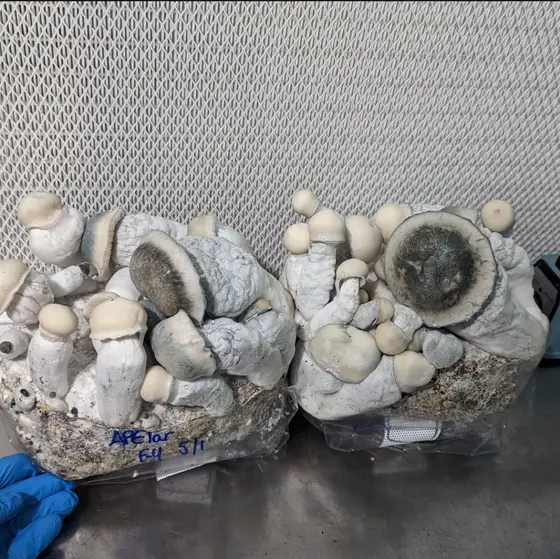
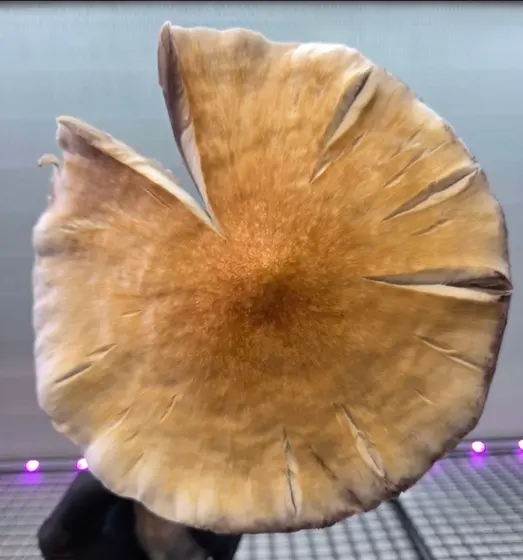
Golden Teacher is the strain most people meet first, and for good reason: it is stable, well documented, and its macroscopic characters are distinctive enough to make it a useful teaching reference. The name refers to the golden-caramel cap colour of the mature fruit body, and the line has been in circulation since the 1980s.
For microscopy it is a sensible starting point precisely because it is so well characterised. If you are calibrating a technique, a stage micrometer or a new objective, working with a strain that thousands of other people have measured gives you something to check yourself against.
 Restocking
 Restocking
![Golden Sattelite [GT x Natal Moon] Spore Syringe 10ml](/thumbs/mw/wp-content/uploads/2026/05/1000043218-scaled.jpg.webp) Restocking
Restocking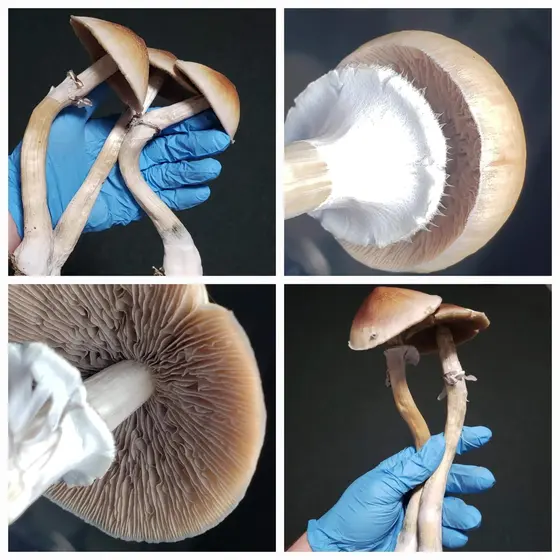 ISORestocking
 Restocking
Golden Teacher and B+ compared
These two are constantly compared because they are the two classic reference isolates, and the honest answer is that under the microscope they are very similar. Both are Psilocybe cubensis, both show the same subellipsoid, thick-walled spore with a distinct germ pore, and both print dark purple-brown.
The differences people describe are macroscopic and cultivation-side: cap colour, cap size, how readily each pins. Those are not things a microscopy library can speak to, and we are not going to pretend otherwise. If you want a uniform slide, take the isolate; if you want genetic spread, take the multispore.
The Golden Teacher family here
Alongside the straight Golden Teacher line, the library carries documented crosses that use GT as a parent. Golden Satellite pairs it with Natal Moon, and APETAR crosses it with A.P.E. Where a leucistic expression has been isolated from the line, it is listed separately rather than folded into the parent.